Showing posts with label Central America and Caribbean travels. Show all posts

Tuesday, January 17, 2012

Return of the refried bean

I worked with Habitat in Guatemala back in 2005, and it was the first time I went anywhere really "exotic"! And unsurprisingly for greedy little me, the recurring memory was that I ate a LOT of beans, and a LOT of plantains. As Honduras is next door, it is not surprising that it again featured heavily on the menu (contributing to my rather heavy hips after the trip :( )

Creature of habit, I ate the same breakfast everyday when we were in Santa Rosa - huevos rancheros (ranch eggs, or basically a fried egg with some tomato salsa on top), with fried plaintains and a plop of the good old refried bean. Thank god I was on a building site everyday afterwards.

We went out several times during our stay, and ate at some varied places including the local pizza joint and a Mexican place. However, it was the local place doing traditional local food that Johny took us to that stole our hearts, to the extent that we demanded to go back again! The food was good and hearty, the recurring theme of beans and plantains somehow transformed to be a bit more interesting. For example, the refried beans were served with a local cheese not too dissimilar to mozzarella in texture, but a little bit more salty, very addictive combination:

Plantains were served with a creamy, slightly sweet and tangy sauce, utterly delicious.

I also managed to sample a local delicacy of conch soup when we were still in San Pedro Sula (the city where we landed, which in the week before we arrived was awarded most murderous city in the world. We got out quickly.) It was a little bit coconutty, but not a lot else other than that I'm afraid. And obviously after the event I am feeling a bit guilty about eating conch, not sure about its endangered status.

And finally for a Lonely Planet shot, every afternoon we enjoyed going to the local coffee shop opposite our lodgings - Honduran coffee is lauded even by Starbucks, and I was happy to see the cafe culture very much alive even in this little town. And my hips got even heavier with the daily cake I was consuming :)

Habitat 2011 - Honduras

This year's Habitat trip brought me to Honduras in Central America. It is a little known country as I found out when I was trying to fundraise, but it has always been a destination for me as Ben, my first ever Habitat leader, raved about doing a Global Village trip there before.

It was my first "corporate build", which is when Habitat is working with a corporation rather than individual volunteers, and I was working with volunteers from the publishing company Reed Elsevier. Reed Elsevier is a huge organisation with over 30,000 employees worldwide, and each of my volunteers were "champions" of their local "RE Cares" community programme. It was very nice to be working with others who are all so committed to helping others, and each of them also were sympathetic with each other's efforts to make other people do more!

Honduras itself is one of the poorest countries in Latin America, and is still recovering from when Hurricane Mitch destroyed much of the country back in 1998, when 6,000 people died and more than 75,000 were made homeless. It is no surprise then that the focus of Habitat's work is to create hurricane and earthquake-proof homes in Honduras, and so far they have helped more than 10,000 families in the country.

We were building in a small mountain town Santa Rosa de Copan, their claim to fame as being the closest big town near to the Copan Ruins. It was a gorgeous little town with cobbled streets and not a lot going on. We were building for a single mother Mariela who has a little girl Sarahy; interesting to note that single mothers did not seem to have the same kind of stigma that they suffer elsewhere. With high unemployment, there is not much to entertain the youngsters of the town, to the extent that Habitat will be building a village especially for single mothers in another future project.

We were only in Santa Rosa for 5 days, as corporate builds tend to be a lot shorter, so unfortunately it did not progress as much as other builds I've been to in the past. We were also rained off for the first day! Luckily, the foundations had already been dug when we arrived:

Here is Mariela with little Sarahy. Her uncle Martin also spent most of the week with us, and he was her main helper on site. His English is non-existent, as is my Spanish, but oh did we get to know each other when we went salsa dancing on the last evening. That man has got good hips!


Our main jobs for the week were to create the "re-bar" steel reinforcements which make the house more earthquake proof, mix cement for the foundation, and start the block work for the external walls.


(and I post a rare picture of me actually doing some work! not many of these exist, ha!)


(I should take a leaf from Abbey's book...)

And by the last day, we got about a quarter up the house! It normally takes 3 months for the normal builders plus the family and helpers to build a house in Honduras, and with our help this will be reduced to 2 months, so we felt slightly better about ourselves.


Even after all these years working with Habitat, I still never fail to have a good cry during dedication. The team in Honduras should also be commended for giving us some of the most warm cultural welcome for our team. We were welcomed by some traditional dancing on our first day, and the last day's dedication had a live xylophone band (hijacked by myself and Liza after not so long, ha!). Much credit to young Johny who looked after us during the build, we couldn't have done it without you. (and also thanks to Rena who I stole all the photos from!)


Thursday, November 24, 2011

No viva la comida :(

I cannot say that I am not fussy about food. There are very few foods that I will refuse to eat, true, but I do have a "no waste of calories" policy - I am so greedy that I will normally reserve my calories for things I think are worth eating, so rarely junk food, and god knows how I survived in with British lunchtimes and the preferences for sandwiches.

Which meant that even 4 days in Havana was a bit of a struggle food-wise. During the economic struggles of the "special period", it seems that the country managed to survive by creating carb-heavy food monstrosities, to the extent that Cuban food culture is pretty dead. Walking around central Havana, and all that is on offer in local places appears to be ham and cheese sandwiches, cheese and ham sandwiches, or pizza, the dodgy thick base kind. Although given that most of these offerings around between US$0.50-2.00 a pop, you can't really argue. I tried the pizza at this place in Habana Viejo, got a pizza bigger than my face for about a dollar served on a piece of A4 paper, and it was fun eating on the street corner with the local bici-taxi drivers.

The other common offering in these local peso restaurants was chuleta de cerdo, basically a pork chop served with rice and beans, deep fried plaintains and salad. This was the only sign of fresh vegetables in the entire time I was in Havana!! Enormous portion for about US$1.50, probably one of the better meals I ate, but it was pretty hard to find in the centre of town. I also tried to find "ropa vieja", a traditional dish literally translating as "old rope", or strips of beef on rice and plaintains, but couldn't find whilst I was there :(

Unfortunately as a tourist, you are normally shepherded towards the tourist restaurants in town, where you pay with CUCs, and then suddenly the price of a meal goes up by 20-25x. Although the service at these places is pretty good, and there are normally more than 2 things on the menu, you do wonder at spending US$25 on a meal when you can buy an ice cream for about US$0.04 on the street.

One of the more famous places is El Aljibe in Miramar, which was walking distance to where I was staying. Apparently the bitter orange sauce that comes with their roast chicken is a state secret, but as soon as I saw the tour buses parked outside I should have known to go elsewhere. It's probably quite popular with the Western tour groups as it is essentially all you can eat chicken with unlimited rice and beans, chips, plaintains, and salad, but the roast chicken itself was really dry and pretty disappointing. Then I find out that it's actually owned by the government, so kudos for them doing such great marketing to make money out of us tourists!!


It was also at El Aljibe that I realised that mojitos in Cuba are not all that! I think the fundamental thing is that no one seems to wash their mint very well, and so there is always a bit of soil floating around in your drink. Even in "posh" places like these... and somehow my blackberry camera thinks mojitos are pink also...


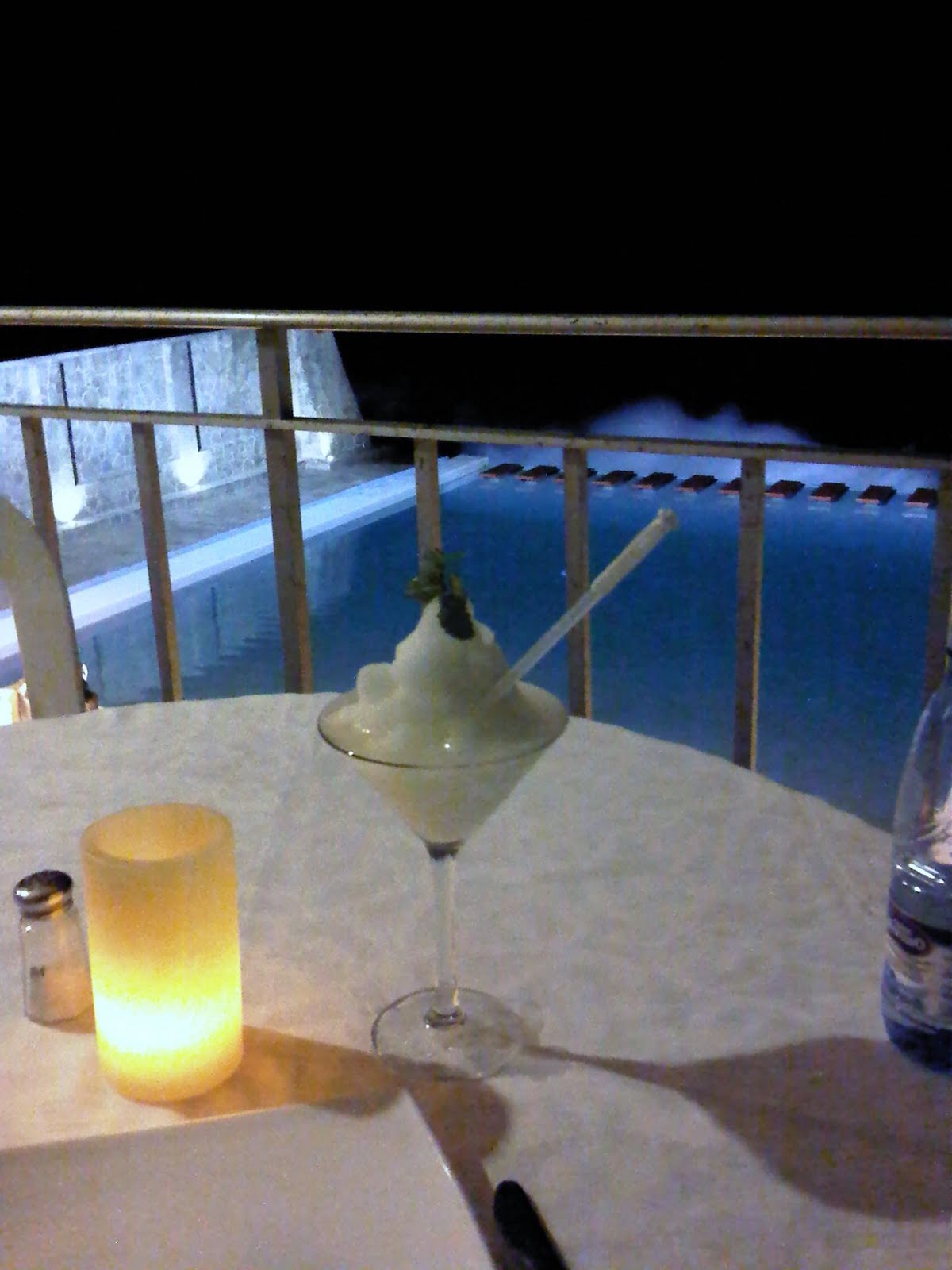
The paladar is a private run, normally family restaurant, that was invented during the special period to let normal families have some kind of additional income other than their government work. Nowadays in Havana, some of these have become big tourist traps, a refuge for those who want something other than their usual ham and cheese sandwich. The paladar again very near my place called Vista del Mar was in a very nice setting, with seaviews and a swimming pool, and an exclusively white Western clientele. Although paladares are not strictly allowed to serve prawns or lobster (there is a government monopoly), it is what everyone has. A side of rice and beans (part of a meal that is US$1.50 on a street) is a rip-off US$3.50 as a side dish. The daiquiri was pretty good though...


But again, you get to thinking that families who run these sorts of paladares must be just rolling in it nowadays. The obviously benefit from the earning in CUCs, spend in pesos practice, not really in keeping with my socialist ideals!

On my last evening in Havana, I had to try the most famous paladar of all. La Guarida was where the Oscar nominated Fresa y Chocolat was filmed, and multiple international newspapers have mounted a lot of praise on their new take on Cuban food. It is so famous that apparently they have hosted Matt Damon, Uma Thurman, and they even have a blog on their website. I must say, the atmosphere of the place is wonderful - you go through a suitably dilapidated entrance to arrive at the top floor of a townhouse, and the restaurant is spread across 2-3 cosy rooms, with tables on the balcony also.

The menu would also not be out of place in a trendy Soho restaurant either. They even served an amuse bouche (!) - some kind of deep fried carrot creation:

I had a lot of difficulty choosing particularly my starter, with items such as papaya lasagne and tuna ceviche. I ended up with a watermelon gazpacho with prawns:

It turned out to be a basic tomato gazpacho with a small scoop of watermelon sorbet and a few little deep fried prawns, so not quite as wow as I thought the description implied, but after a hot day of walking around the city, it was refreshing and just what I wanted.

The mains are a little less exciting, and I settled on a fillet of grouper served with a sauce that is traditionally from Guantanamo - can't remember the Spanish name, but basically a lemony white wine reduction with onions. More amusing was I asked for some simple vegetables on the side, and all they could offer me was either sweet potatoes or yuca - no wonder I put on nearly half a stone during my holidays!

I guess people love this place because again, it is a refuge from the monotony of normal Cuban food offerings, but I wouldn't say it is *that* amazing. It's not that cheap either as this meal came to around US$40 with a glass of slightly dodgy tasting cabernet sauvignon.

Somewhat ironic also that when I had my overnight layover in Miami, all the restaurants outside my hotel were Cuban. All the good Cuban food now is probably in the US. Food does seem to be the big casualty of the communist era, but I also wonder how important food is to Cubans in general. They seem far too busy dancing and drinking Havana Club!

Viva La Habana!

I'm notoriously bad at keeping up this blog, but my trip to Cuba was probably one of the most amazing in a long long time, it moved me to write!

My friends have always joked about my left-wing leanings, and I've been talking about going to Cuba for the longest time. It is a funny holiday destination: it is a refuge for frozen Canadians looking for winter sun, and there are plenty of beach resorts like anywhere else in the Caribbean. Such a shame as these tour groups generally stay out of Havana, which I found to be one of the most intellectually stimulating, fascinating places I've ever been to.

Culturally, Cuba does not feel like a communist country. Cinema, dance, visual arts, sports, these all not only strive but the Cubans appear to be amazing at being creative all round. My favourite area in the city was Vedado, where there is the Institute of Film and what felt like a cinema or art gallery on every street corner. My favourite museum was by far the Museo Nacional de Bellas Artes, where there is an entire building devoted to Cuban art. Castro's version of communism greatly encourages the arts, but I think it is also in people's blood to appreciate these finer things in life.


The architecture of Havana is also gorgeous. There has been a conscious government programme to improve the areas around Habana Viejo, and most of the old town looks amazing, with some of the loveliest squares to walk around. I also loved all the Art Deco that has survived - there are absolute monstrosities of pink and green to be found, but also lovely places such as the Bacardi building and random street signs:


The family that I stayed with were also thoroughly comfortable and middle class. Mauricio and his second wife Diana lived in Miramar, about 15 minutes car ride from the centre, in the penthouse apartment in one of the nicest suburbs. This was the view from their balcony, overlooking the Malecon and Caribbean Sea:


Mauricio's father used to be relatively well off before the Revolution, and as a result they were left with a rather big house, which meant they could trade it for this amazing penthouse apartment. The remnants of this has meant that Mauricio quit his government job about 10 years ago, and his sole income now comes from renting out his two spare rooms to tourists like me. His family is the model Cuban family: his daughter is in Brussels, sponsored by the government to study Art History abroad; his step-daughter is doing a degree in Graphic Design, and step-son is a rock band (very good taste in music and loves Radiohead!) and wants to be a sound engineer in TV production. Mauricio and Diana seem to spend their days chilling on the balcony and watching Brazilian soap operas at night.

The only slightly dodgy thing in his house was the shower, which only has hot water through an electric shower head, something I haven't seen since I was in Tanzania!! Hmmm, who's great idea was it to have exposed wire so close to water...

Of course, life is not this rosy for everyone in Cuba, even Mauricio acknowledges that in Havana, he is a rich man. The most fascinating conundrum for me stems from the dual economy in Cuba. After the Soviet Union collapsed in 1990, with subsidies for Cuba disappearing overnight, tightened by the US trade embargo, Cuba's economy was plunged into darkness, and very briefly, the country experimented with legalising the US dollar, before settling in the current system of having two currencies both active in the economy. The government allowed limited private enterprise in small businesses such as family restaurants and apartment rentals, and these private enterprises earn in Cuban Convertibles, or CUCs. On the other hand, all government employees are paid in the national currency, the Cuban Peso, where the exchange rate for CUCs to Peso is currently 1:25.

I understand why this came about, but I remain extremely confused by how this system works on a practical level in the present day. In reality, most things tourists have in contact with, such as the nicer restaurants, taxis, supermarkets, all work in CUCs, whereas 95% of the population trade in Pesos. But at the same time, CUCs and Pesos can be exchanged very freely on street corners, no passports or documents required. This means that for fortunate Cubans such as Mauricio, he can earn in CUCs and spend in Pesos, making him an extremely rich man indeed. How sustainable this is, I really do question, as there is an obvious financial apartheid for those who can benefit from being in the middle of these two economies.

I really only scratched the surface I felt in the very short time I was in Cuba, to the extent that I now joke that I have to go back to write my PhD. I also met someone randomly in a bar who extolled to me exactly what he thought was wrong with Cuba. This Ghanian born 30-something man was probably trying to pick me up and earn a few free Cuba Libres off this obvious tourist, but turned out to be the offspring of idealistic communists who took him to Cuba when he was very small. Now apparently working as an English and music teacher (his English really wasn't good enough to be teaching!!), his big plan in life is to get out of Cuba.

It was interesting to speak to him, but he got thoroughly irritating after a while. According to him, the biggest problem with Cuba is the lack of freedom, not necessarily in terms of your expression, but he felt he was being watched at every turn, and you cannot do anything due to the number of police roaming the streets. I have to admit that I noticed this - I never felt so safe walking around a major city in the middle of the night, especially as street lighting is less than reliable - but his paranoia was quite extreme. He was also clutching a copy of Catcher in the Rye, which apparently is banned along with many other books including 1984, Brave New World... I'm trying to verify whether this is true: one of the other things I noticed in Havana is the number of bookshops absolutely everywhere (not to mention the huge second hand book markets in the city squares), but you also notice that there are a LOT of political writings dominating these bookshelves: the usual Marx, Castro, Jose Marti... Lastly, he complained that Cuba is an extremely racist country, with the blacks concentrated in ghettos in Central Havana whilst whites live middle class lives out in the suburbs. I was not in Havana long enough to truly understand this, but when I got up to leave after refusing to buy him another round, and he complained that I was being racist, I did feel like this guy had a huge chip on his shoulder.

A city of mass contradictions? Certainly. Something I want to find out more about? Absolutely. Ultimately, currently living in the uber-materialistic world of Hong Kong, simply walking around a city where recycling is a necessity not a fashion, where there are not even corner shops, where supermarket shelves are not in abundance, I found Cuba to be an absolutely refreshing experience. A shame then that food culture is indeed an oxymoron in this country, because otherwise I would be back there in a shot.